
A Mysterious Photograph and the History Behind One of San Francisco's Most Storied Coastlines
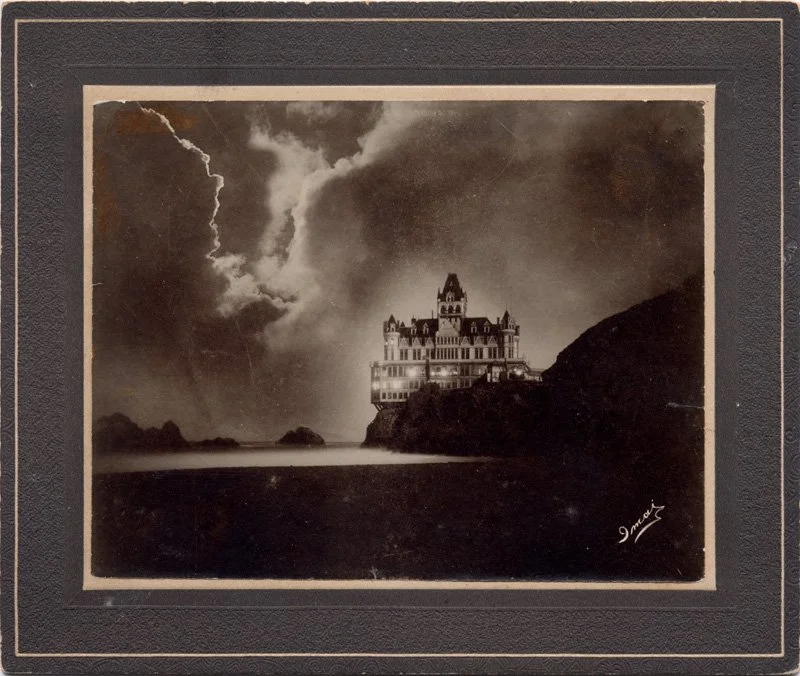
Source: The Cliff House Project
The Lightning Photo
I was on my way to Lands End for an engagement session recently, thinking about a photograph almost every San Franciscan has seen at some point. People call it the Lightning Photo, and it has circulated for well over a century on postcards, in books, and in the kind of cheap reproductions you find tucked into a frame at a flea market or an antique shop. I have one of these reproduced prints and I am fascinated by the magic and mystery this image holds. Whether actual lightning appears in that sky is something photographers and historians have debated for decades. As someone who has worked with film, my instinct has always leaned toward darkroom manipulations rather than a lightning storm; however, the mystery of how it was made is part of what makes the entire story so compelling.
I had known the photograph and its local legend for most of my career as a San Francisco wedding and engagement photographer. What I had not done was search for more about the photographer and circumstances behind it.
So I did. And the story I found, about a photographer, a city built and rebuilt by fire, and a stretch of coastline that has been disappearing and reappearing for over a century, is incredible. I love this part of the Bay Area and frequently bring couples and families for portraits. Understanding what came before and who stood here with a camera before me, only deepens how I see it now.
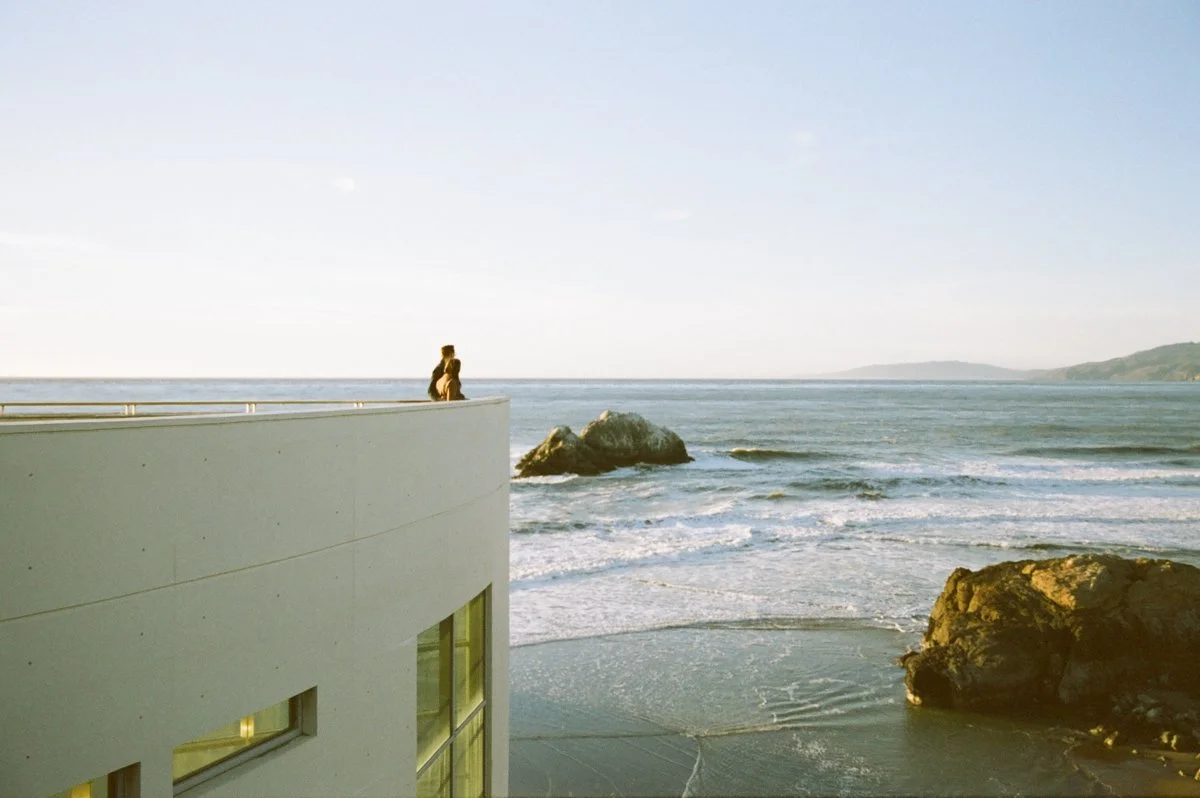
At the top of the (current but now under renovation) Cliff House, looking out over Ocean Beach.
The Place First
Lands End sits at the northwestern tip of the San Francisco peninsula, where the land gives way to the Strait and the Pacific opens up beyond it. It is my favorite place in this city, and I bring couples and families here often for engagement sessions and portraits. The trails wind through coastal scrub above the water, the light shifts quickly and dramatically, and the ruins of the Sutro Baths sit at the base of the cliffs like something out of another century, which in many ways they are.
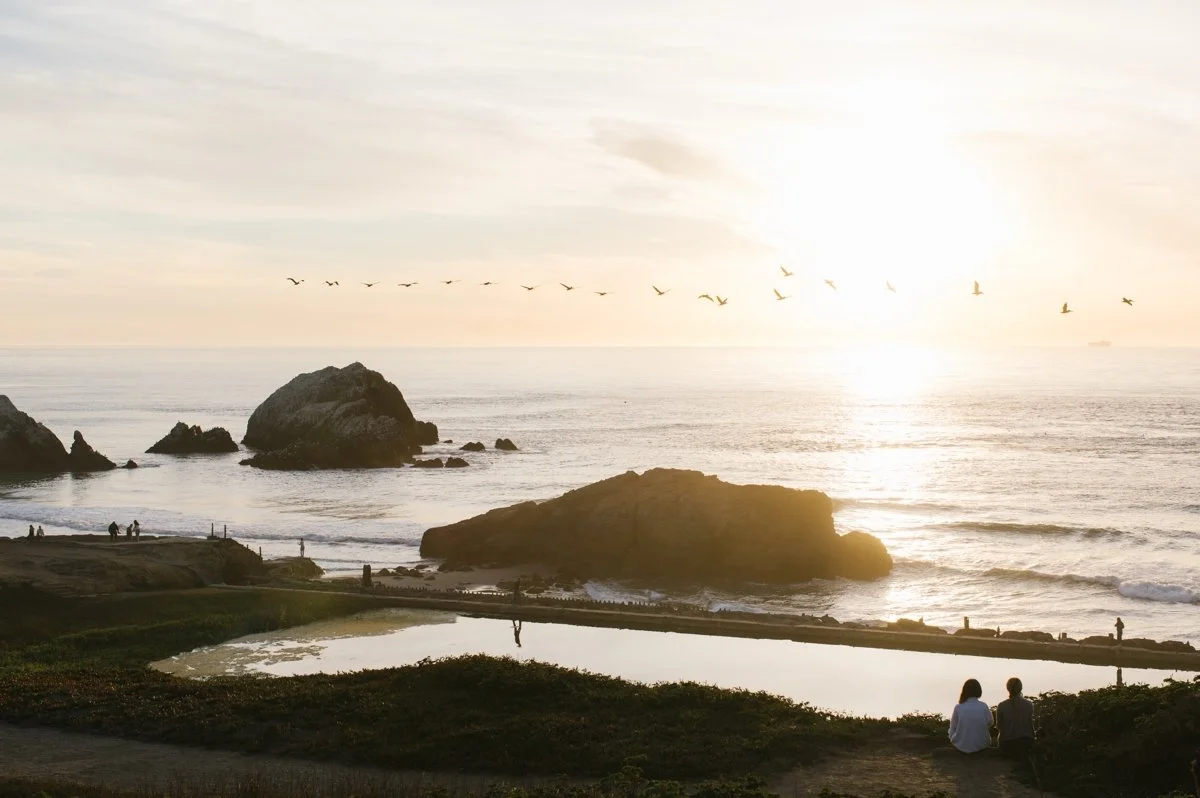
The view of the ruins of Sutro Baths at sunset is always spectacular.
The Sutro Baths were opened in 1896 by Adolph Sutro, a self-made millionaire who also served as mayor of San Francisco, and who owned the Cliff House just to the south. When they opened, the Baths were the largest indoor swimming complex in the world, enclosing seven saltwater pools and one freshwater pool beneath a vast glass and steel roof, with capacity for ten thousand visitors at a time. During high tide, ocean water flowed directly into the saltwater pools through a tidal inlet, filling them in under an hour. Admission was ten cents for adults.
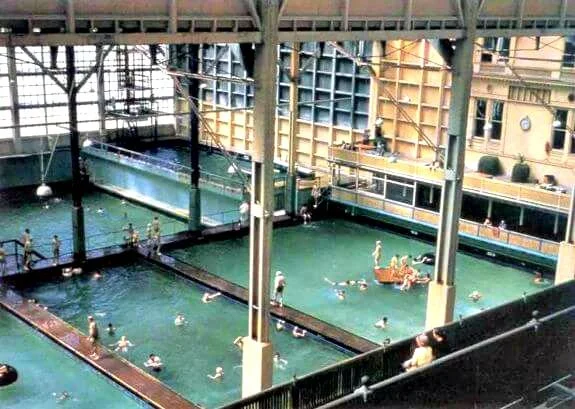
Inside Sutro Baths in 1943. Source The National Parks Service.
The Baths struggled financially for decades, eventually converting to an ice rink, and by 1964 the property had been sold to a developer with plans to build high-rise apartments. During demolition in 1966, a fire broke out. It is believed the fire may have been deliberately set, and that the developer collected the insurance money and left San Francisco shortly after. What remained were the concrete foundations, the tidal pools, and the cave-like tunnel at the water's edge that visitors still walk through today.
The Cliff House beside it has had an even more dramatic history. The first was built in 1863 as a modest seaside resort that drew San Francisco's most prominent families by carriage across the dunes. After years of fires, an explosion from a dynamite-laden ship that ran aground on the rocks below, and a reputation that reportedly declined into gambling and disreputable behavior, Adolph Sutro purchased the property in 1881 with the intention of restoring it as a wholesome, family-friendly destination. He ran a railroad line to bring the public out to the coast.
On Christmas Day 1894, fire destroyed it entirely. Sutro rebuilt, reopening in 1896 with extraordinary ambition: an eight-story Victorian castle with turrets, decorative spires, an observation tower, private dining rooms, a gem exhibit, an art gallery, and panoramic windows facing the ocean. It was visited by five American presidents. It survived the 1906 earthquake, only to burn in an electrical fire the following year, in 1907, just as it was being prepared to reopen after renovations.
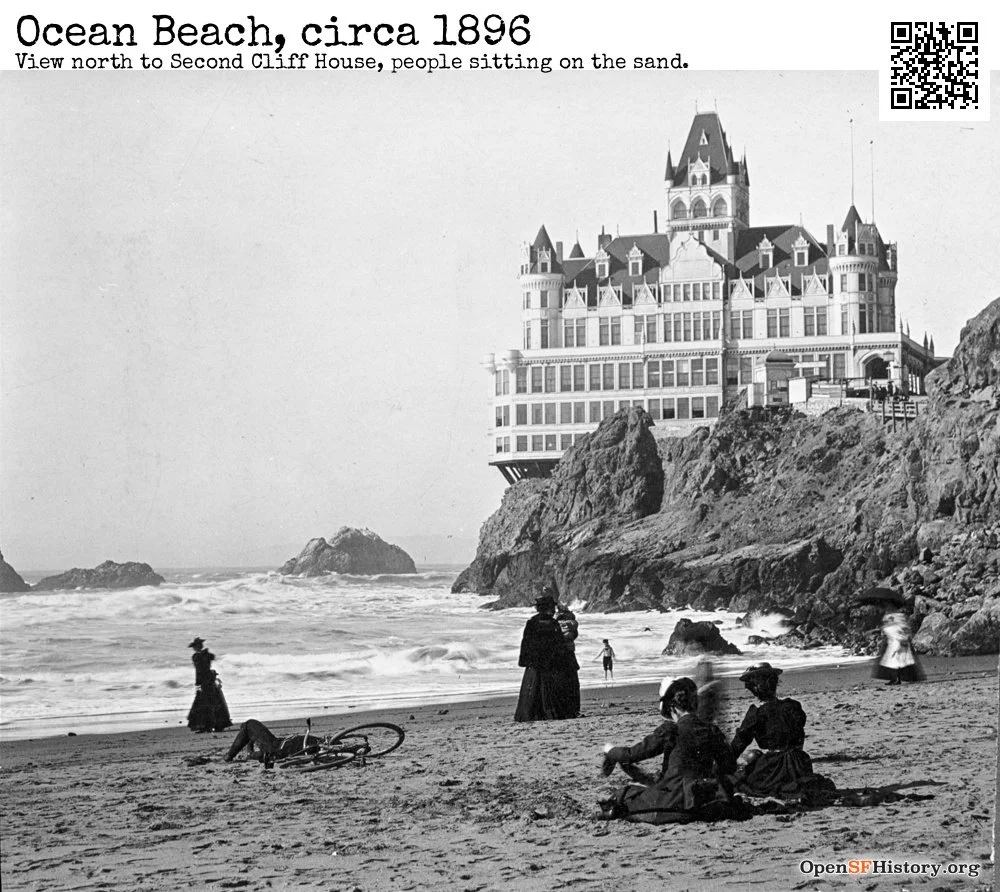
Source Open SF History
Sutro's daughter Emma constructed the Cliff House a third time, in a simpler neoclassical style. That building, substantially reconstructed in 2004, is the one that has sat empty since December 2020, closed after the previous operators could not renew their lease with the National Park Service, which has owned the property since 1977. A new operator is currently undertaking a restoration expected to cost upward of twenty million dollars. The building is expected to reopen in late 2026, and after a lengthy trademark dispute, it will once again be called the Cliff House, a name whose rights were recently donated to the Western Neighborhoods Project, a nonprofit dedicated to preserving the history of western San Francisco.
All of which is to say: this particular stretch of coastline has had a lot of activity and history in the past hundred and sixty years. It is fitting that the ruins are not the end of the story.
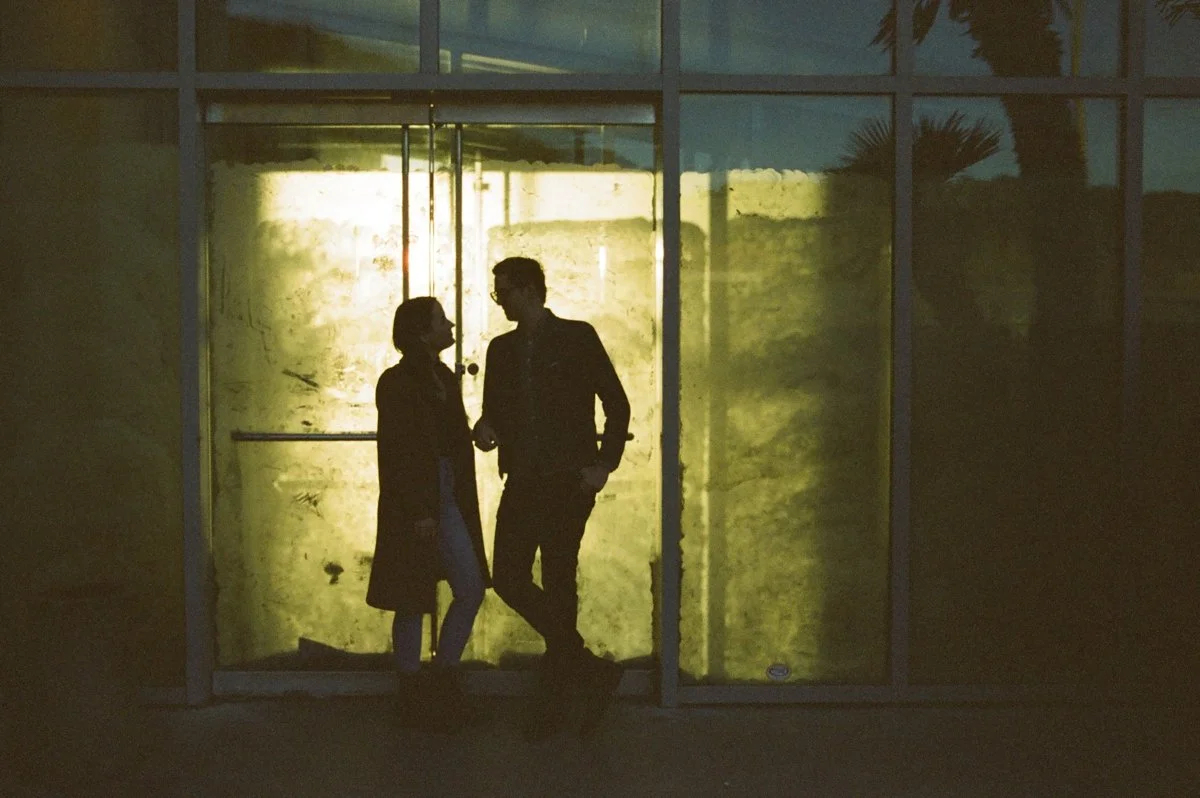
At the entrance to the closed Cliff House in 2023
The Photograph and Its Creator
The image known as the Cliff House Lightning Photo is believed to have been made around the turn of the twentieth century and is attributed to a man named Tsunekichi Imai, described in historical records as likely the first Japanese commercial photographer in San Francisco. He operated a studio at 1303 Polk Street and later at 1950 Bush Street, where the studio and the family home were one and the same. He was born in 1872 in Yamaguchi, on the southern Japanese island of Honshu, learned his craft in Japan, and immigrated to California in 1899, part of a wave of Japanese workers drawn to California during a labor shortage. He and his wife Taki eventually had seven daughters and one son.
The story of how it was made may be even more interesting than the image itself. The back of the original print carries an inscription, neither dated nor officially verified, describing a young Japanese man who rode the last streetcar out to the Cliff House at ten-thirty at night, positioned himself on the beach with his camera, and waited until two in the morning to capture the lightning by leaving the shutter open. It is a vivid and appealing story. It may also be, at least in part, a fiction.
According to Ted Imai, the photographer's son, his father told him over the years that the photograph was taken in broad daylight and then transformed in the darkroom over the course of four or five days, retouching and redeveloping the image by trial and error until he achieved the dramatic, dark-sky effect. Ted was not born when the photograph was taken and could not recall the specific techniques or chemicals his father used. An atmospheric physicist consulted by the researcher who assembled this account offered a different view, suggesting the unusual light configuration in the sky looked entirely authentic to him and would have been difficult to manufacture artificially. A former printer at one of San Francisco's oldest studios offered a third version, describing a process of double exposure and deliberate manipulation to achieve the cloud effect.
More than a century later, the question of how the image was made remains genuinely open. What is not in dispute is that it became one of the most reproduced photographs in San Francisco history, appearing on postcards, in books, and on walls across the city, and that for many years the name of the photographer was not attached to it at all. The Imai family eventually prevailed upon a publisher to add the credit.
Ted Imai described his father as an inveterate practical joker, and the researcher who compiled his account suggested the mythologized story on the back of the print was likely written with the photographer's full knowledge and approval, intended to make the image more saleable. Whether the sky was nature's own or Imai's invention, the image sold.
What the Camera Witnessed
Tsunekichi Imai's life in San Francisco was shaped by events far larger than any photograph.
He was in his Polk Street studio when the 1906 earthquake struck. In the days that followed, officials dynamited a firebreak east of Van Ness Avenue to stop the spreading fire, and the Imai studio stood in the path of those buildings. He assumed everything was lost. A neighbor suggested he walk to Lafayette Park, and there he found his equipment and furnishings piled under tarpaulins, labeled with his name, rescued by firefighters and volunteers before the demolition. He photographed the aftermath extensively. His son recalled one image in particular: a man trapped on the upper balcony of a burning building as soldiers below shot him to spare him from the flames. Imai, fearing the legal consequences of having witnessed and photographed the event, eventually destroyed the print.
He went on to photograph the 1918 influenza epidemic, the victims of which he documented so that their images could be sent back to families in Japan. He photographed Prince Fushimi of the Japanese Imperial Family and received a silver cigarette case and sterling matchbox in gratitude. He photographed Joaquin Miller, the poet of the Sierras, and carried his camera through decades of a city that was continuously becoming something other than what it had been.
Tsunekichi Imai died in 1929. The photographs and personal effects he left behind survived the earthquake. They survived the fire. Many did not survive the Second World War. When Executive Order 9066 forced the removal of Japanese Americans from the West Coast in 1942, the Imai family, along with more than a hundred thousand others, was sent to an internment camp at Topaz, Utah. In the desperate hours before departure, families had to decide what to do with everything they owned. Storage facilities filled quickly. Some people buried belongings in their yards or hid them under floorboards. The Imai family concealed photographs in a garage at their Pine Street home. Most were never recovered. The prints and glass plates that had outlasted two of the greatest disasters in San Francisco history were lost in the chaos of forced removal.
Some were found decades later, by chance, when a woman cleaning out her parents' home in Redwood City came across a cache of old photographs discovered in a garage joist space and tracked the Imai family down through the Japanese American History Archives to return them to Ted Imai. He recognized them immediately. Most were photographs of himself as a young boy, his father's favorite subject.
What Remains
I think about this when I am at Lands End with a couple, walking the trail above the water, waiting for the light to do what it does in this particular place at this particular hour.
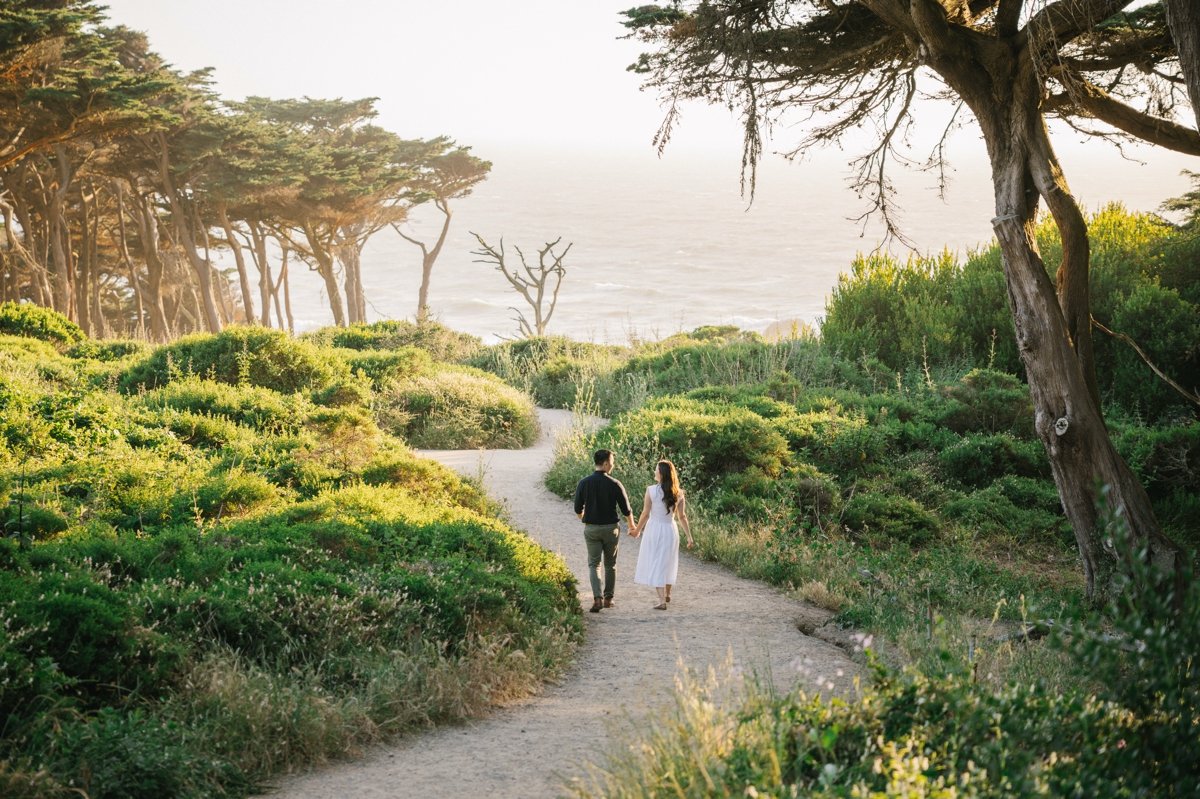
Winding through the pathways at Lands End.
Photography has always been an act of preservation in the face of impermanence. The Cliff House’s many lives. The Sutro Baths exist now only as concrete outlines filling slowly with tidewater, and as a tunnel that couples walk through while I photograph them from the other side. Tsunekichi Imai made an image of a building that would be destroyed within a decade, possibly in daylight, possibly by darkroom alchemy, and it has outlasted almost everything else from that era.
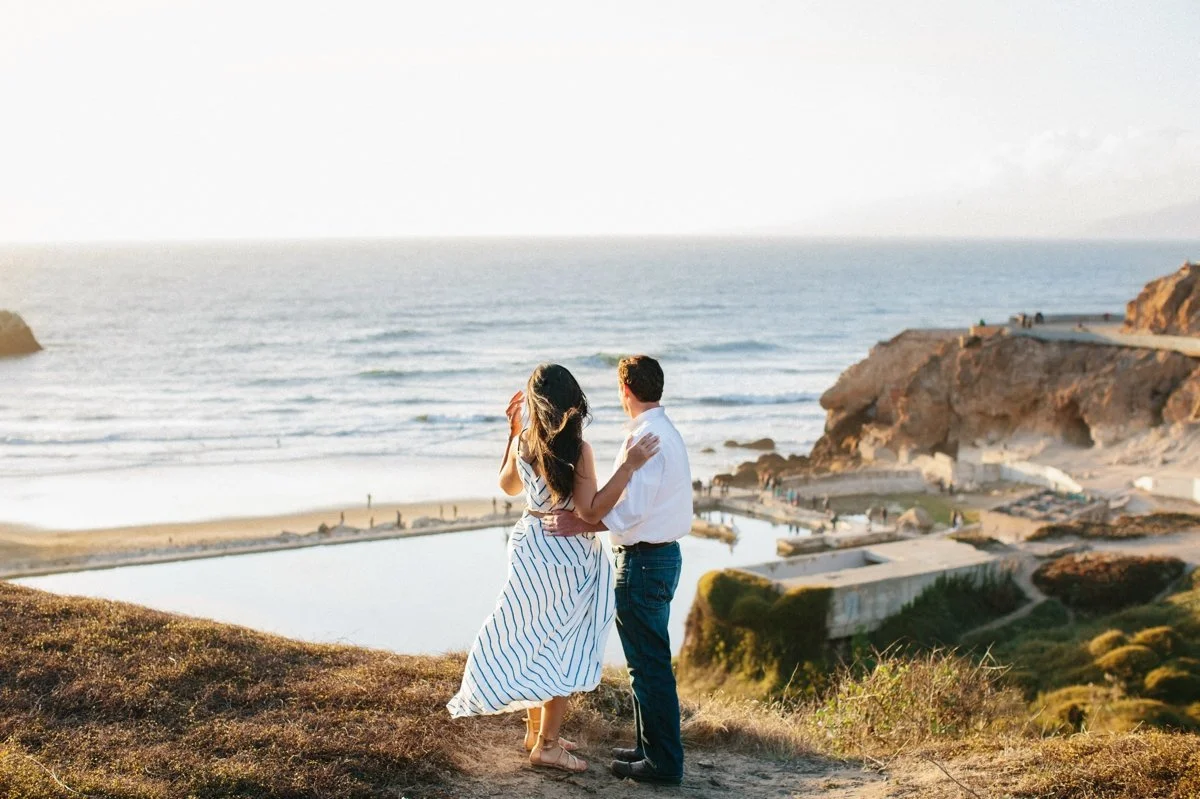
The epic views of Sutro Baths meeting the Pacific.
The ruins at Lands End are among the most atmospheric places I know to photograph. There is something about standing where a building once stood, where the land meets the water in exactly the way it always has, that makes the present feel both more fragile and more vivid. Couples and families feel it too, even if they cannot quite say why.
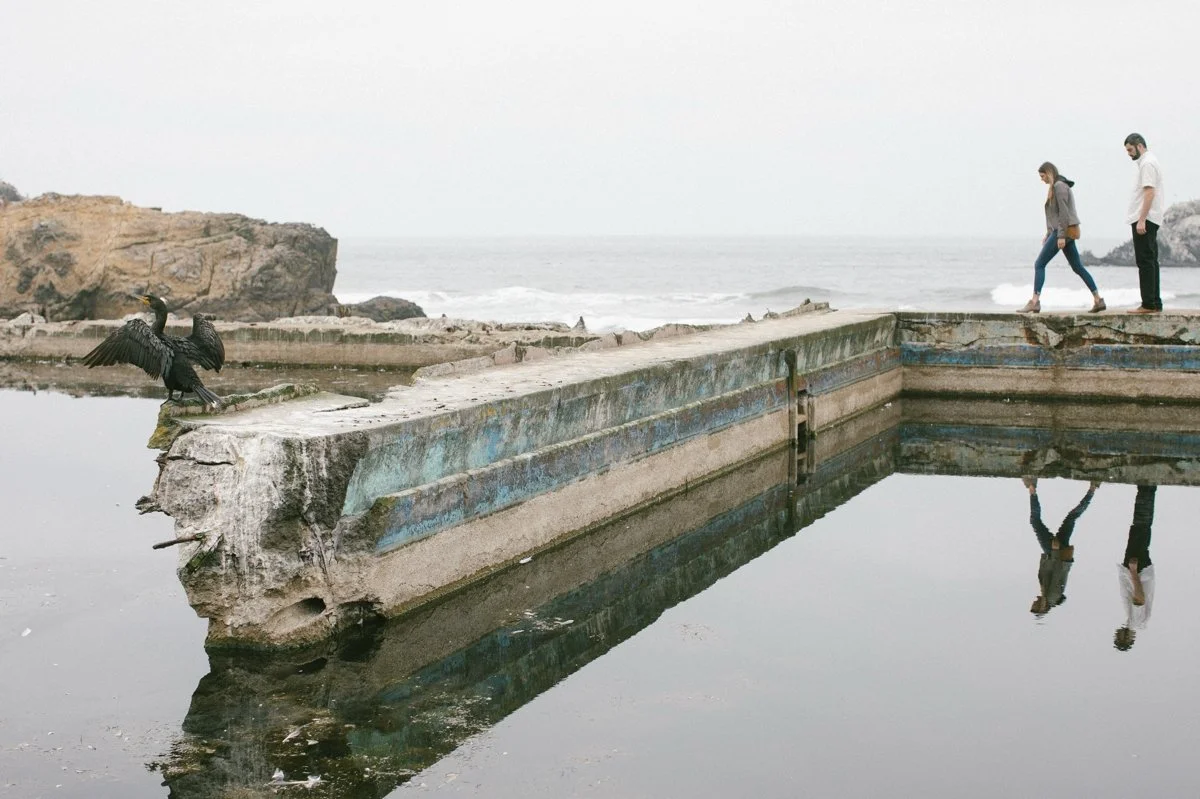
The ruins of Sutro Baths, returning to nature.
I am drawn to places that carry their history visibly, and Lands End carries more than most. If you are planning an engagement session, bridal portraits, or a family session in San Francisco and want the photographs to hold a sense of place, I would love to talk about what this spot might hold for you.
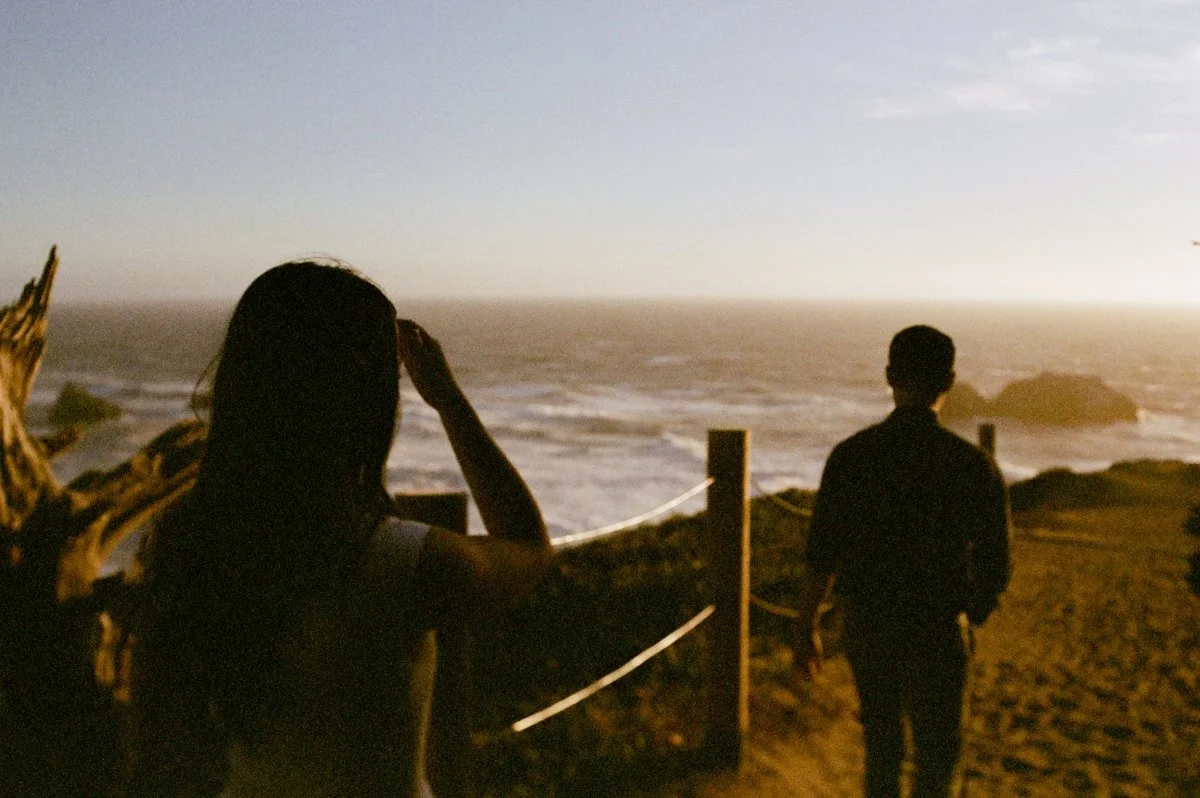
In collaboration with The Lifestyle Historian
You can see more of my work from this area here: engagement sessions at Sutro Baths, family portraits in the sea cave formed by the ruins, and strolling along Ocean Beach and around the Cliff House on film. The light here is different every time. That is exactly why I keep coming back.
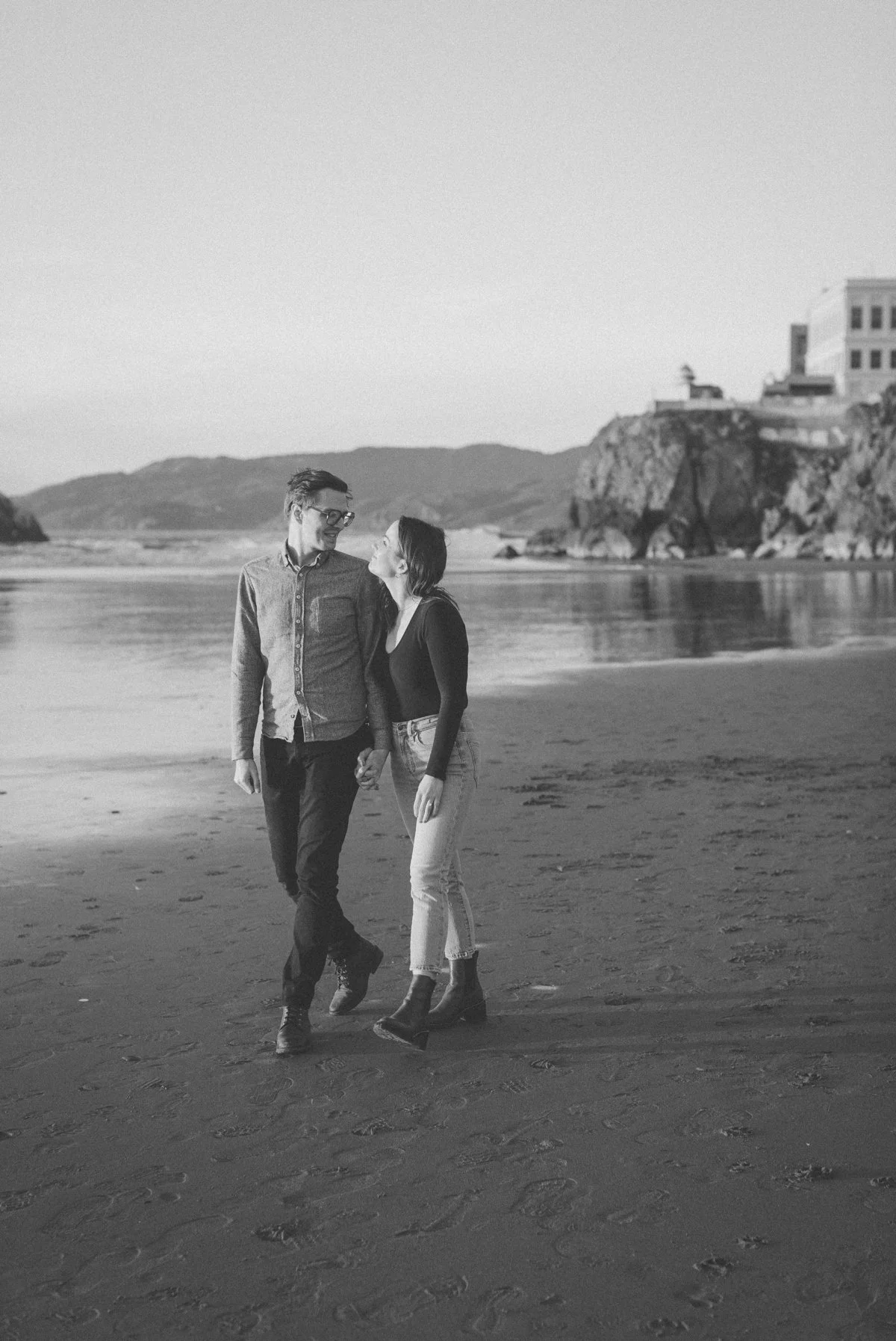
Walking Ocean Beach with the Cliff House in the background.